
.png)


We have all seen the demo. An engineer types a question in plain English, and an AI agent springs into action — pulling data, reasoning across systems, producing an answer that would have taken a human hours. It is genuinely impressive. It is also, most of the time, exactly where the story ends.
Across our industry, agentic AI is having its moment. Proofs-of-concept are everywhere. And yet, if you ask how many of those polished demos are actually running in production — operating real infrastructure, trusted with real consequences — the number collapses. The gap between a compelling demo and a deployed system is the single hardest problem in applied AI right now.
Here is what I have learned building agentic AI for live networks: that gap is almost never about intelligence. The models are good enough. The gap is about trust, governance, and architectural discipline — the unglamorous engineering that decides whether an AI agent is safe to let loose on something that matters.
Why agentic AI stalls on the way to production
A demo runs in a sandbox where nothing is real and nothing can break. Production is the opposite — and that is where the failure modes surface.
- Hallucination meets a live system. In a chat window, a confidently wrong answer is an annoyance. On a live network, an agent that invents a device name or misreads a status can trigger a real action with real consequences.
- Ungoverned actions. An agent powerful enough to be useful is powerful enough to be dangerous. Without strict limits on what it may touch, the same autonomy that impresses in a demo becomes a liability in production.
- No auditability. When an agent does something unexpected, you must be able to answer: what did it do, why, and on whose authority? If you cannot reconstruct that, you cannot operate it — and no serious operator will deploy what it cannot audit.
- Brittle architecture. A prototype wired together to survive a demo rarely survives contact with the messy, high-volume reality of a production environment.
- The quiet killer — user acceptance. Even a technically sound system fails if the engineers who must rely on it do not trust it. Trust is earned through transparency, consistency, and control — not through a clever demo.
What production actually demands
Crossing the gap is less about making the AI smarter and more about engineering the system around it to be trustworthy. Four disciplines matter most.
1. Governance by design. Not governance bolted on at the end, but built into the first line of code. Every action an agent takes should pass through authentication and role-based access control, so it can only ever do what the user is permitted to do. Credentials encrypted. Sessions isolated. Guardrails checking every input, output, and action. And everything logged, so every decision is auditable after the fact.
2. The right agent architecture, from day one. How an agent plans, selects tools, and accesses systems is a foundational decision, not something to retrofit. Getting it right early is the difference between a system that scales into production and a prototype that has to be rebuilt to get there.
3. A human in the loop for irreversible actions. The most important design choice we made was also the most humble: the agent is brilliant at investigation and diagnosis, but it does not take irreversible action on its own. Autonomy is earned in steps, not seized in one leap. Keeping a human at the point of consequence is not a lack of ambition — it is what makes the ambition deployable.
4. Performance benchmarking. Trust also has to be measurable. That means putting hard numbers on how well the agent actually performs — testing its accuracy and reliability properly, on a solid and repeatable test set, rather than relying on the impression a demo gives. A real, defensible number is what turns “it works in our tests” into evidence an operator can trust: something that can be compared, validated, and stood behind rather than simply asserted.
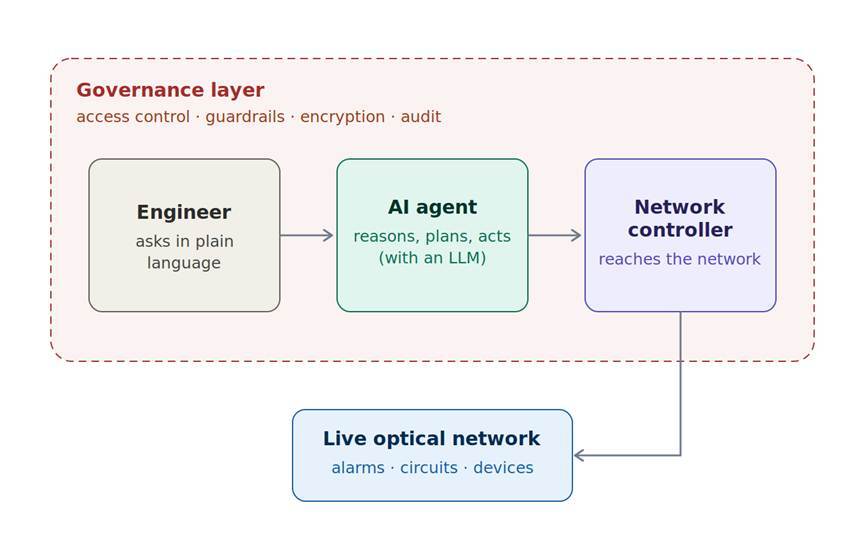
A governed agentic architecture: the engineer asks in plain language, the AI agent reasons and acts through a network controller, and every action passes through a governance layer of access control, guardrails, and audit. Trust is built around the flow, not added after it.
What it looks like when it works
This is not theoretical for us. We built an agentic network-operations assistant and deployed it into a global network operator's production environment — a live optical network, where the margin for error is about as small as it gets.
The everyday problem it solves is familiar to anyone who has run a network. To investigate a single fault, an engineer juggles a fistful of separate systems — alarms here, inventory there, topology somewhere else — under time pressure, acting as the human glue between them. Our assistant replaces that with a conversation: the engineer asks in plain language, and the agent does the cross-system investigation and comes back with an answer.
But the reason it earned a place in production was not the natural-language interface. It was the discipline underneath it — governed tool access, encrypted credentials, guardrails on every step, isolated sessions, full auditability, and a human retained for anything irreversible. That is what made it trustworthy enough to deploy.
And the results bear it out: roughly 98% evaluation accuracy across a rigorous test set, over 30% lower running cost through deliberate engineering, and — the metric that matters most — real, active use by engineers in a production network.
The takeaway
If your agentic-AI initiative is stuck between a great demo and a real deployment, the instinct is to reach for a better model. In our experience, that is rarely the bottleneck. The bottleneck is trust — and trust is an engineering outcome, not a model capability.
Production is not the finish line for intelligence. It is the finish line for trust.
Build for trust first — governance, architecture, and human oversight — and the intelligence finally gets to do its job where it counts.
Manuj Nayak leads AI engineering practice at VCTI, where the AI Centre of Excellence builds production-grade AI for optical and broadband networks. Views are the author's own.
